Privacy by Design Principles That Build Unbreakable User Trust
Learn the 7 foundational Privacy by Design principles and how to implement them in your organization to build user trust and meet regulatory requirements like GDPR.
Privacy by Design isn't just a technical standard; it's a fundamental shift in how we think about building technology. It's about weaving privacy directly into the fabric of your systems and processes before you even start, rather than trying to bolt it on as an afterthought. Think of it as making privacy the factory default, not an optional extra.
Understanding Privacy By Design And Why It Matters
Let's use an analogy. When you build a house, do you put the locks on the doors after you've moved in, or do you include them in the original architectural plans? Of course, you build them in from the start. That's exactly what Privacy by Design (PbD) does for technology. Instead of scrambling to fix a privacy breach after it happens, you build systems that are designed to prevent them from ever occurring.
This whole philosophy was spearheaded by Dr. Ann Cavoukian, who saw the need to move privacy from a reactive, damage-control function to a proactive, preventative one. The goal is straightforward but powerful: anticipate privacy risks and design them out of the system before they can cause harm.
A Proactive Mindset, Not A Restrictive Checklist
It's really important to see PbD as a mindset, not just a compliance checklist to tick off. It's about committing to creating trustworthy digital experiences from the ground up. This means asking some tough questions early and often during the development cycle:
Do we really* need to collect this specific piece of personal data?- Can we design this feature to work with the absolute minimum amount of user information?
- Are we giving the user genuine, easy-to-understand control over their own data?
- How are we securing this data from the moment we collect it until the moment we securely delete it?
By making privacy the default setting, you ensure that people are protected automatically. They don't have to navigate confusing menus or opt-out of invasive settings to be safe; the system is designed to protect them from the get-go.
This approach builds a rock-solid foundation of trust. When your users feel confident that you respect and protect their privacy by design, they're far more willing to engage with what you've built. This is particularly crucial when dealing with sensitive information, which is a core reason why document privacy matters so much in today's business environment.
To make this distinction clearer, let's compare the two approaches side-by-side.
Privacy by Design vs Traditional Security
This table quickly breaks down the core differences between a proactive privacy mindset and a more traditional, reactive security model.
| Aspect | Privacy by Design (Proactive) | Traditional Security (Reactive) |
|---|---|---|
| Timing | Embedded during the initial design phase | Applied after development, often post-launch |
| Goal | Prevent privacy incidents from happening | Respond to and mitigate breaches after they occur |
| Approach | Holistic, integrated into core functionality | Perimeter-based, focusing on external threats |
| Data Focus | Data minimization (collect only what's necessary) | Data accumulation (collect now, secure later) |
| User Control | Empowering users with default-on privacy | Users often must opt-out of data collection |
| Default State | Private by default | Open by default, secured with add-ons |
Ultimately, a robust security posture is still essential, but Privacy by Design ensures that the very system security is protecting has been built with user privacy at its heart.
The Driving Force Behind Modern Regulation
The impact of these principles is impossible to ignore. As our lives become more digital, governments and regulators are demanding stronger data protection. In fact, Gartner predicts that by 2024, 75% of the global population will have its personal data covered by modern privacy regulations.
Many of these laws, like GDPR and CCPA, are heavily inspired by the proactive mandate of Privacy by Design. This global trend makes one thing crystal clear: baking privacy into your products from day one isn't just good ethics—it's a fundamental business and compliance requirement.
The 7 Foundational Privacy By Design Principles Explained
At the heart of Privacy by Design (PbD) are seven core principles that serve as a blueprint for building trustworthy systems. Don't think of them as rigid, checkbox rules. Instead, see them as a guiding philosophy that weaves privacy into your product's DNA right from the start, rather than treating it as a last-minute patch.
This framework gives you a clear way to make decisions that consistently respect and protect user data.
The whole idea is to shift from a reactive, "damage control" model of security to one that is proactive and baked-in from day one.
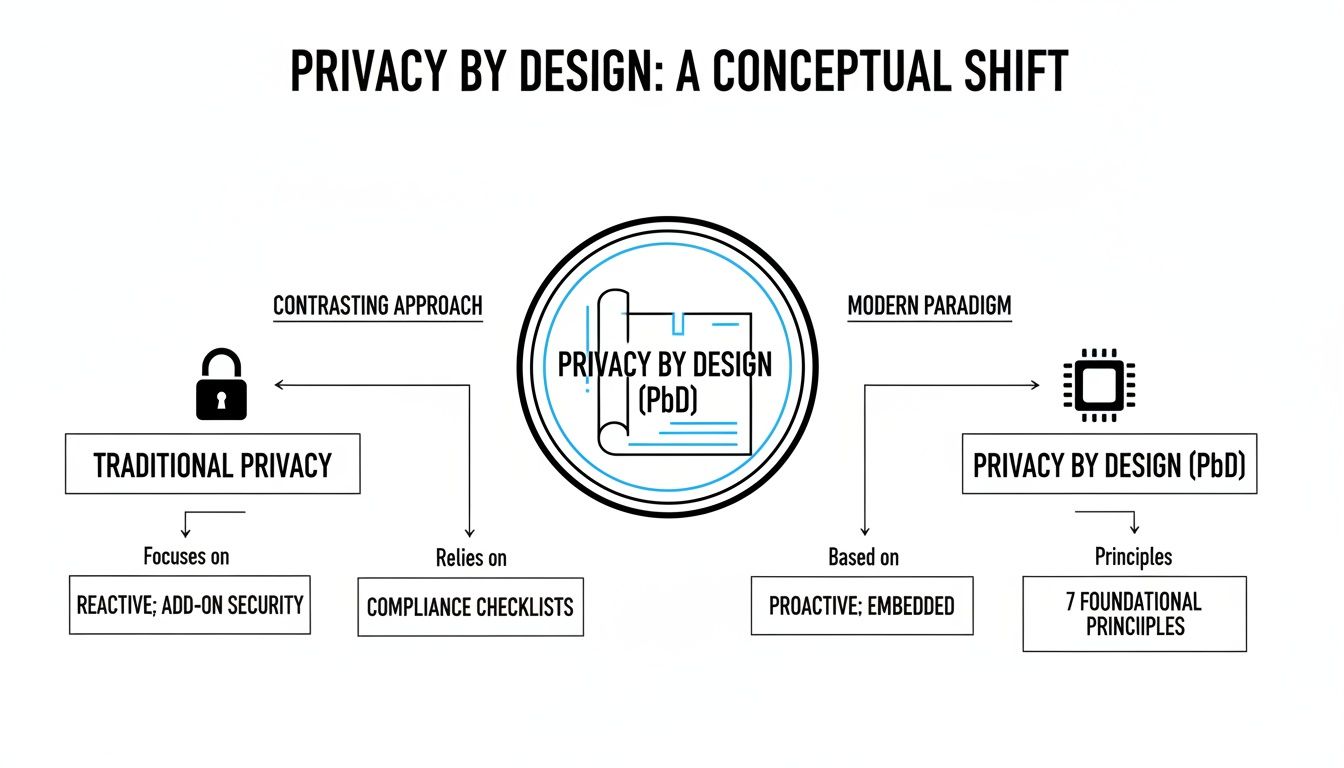
With PbD, privacy becomes an essential feature, not an external lock you add on after the fact. Let's break down each of the seven principles to see how they work in the real world.
1. Proactive Not Reactive; Preventative Not Remedial
This is the big one—the cornerstone of the whole philosophy. You have to anticipate and head off privacy risks before they can ever become a problem. It's the difference between building a flood barrier before the storm hits and trying to mop up the water damage afterward.
A reactive approach only deals with problems after they've already caused harm, which destroys user trust and racks up huge costs. A recent IBM study found the average global cost of a data breach hit a record $4.35 million. That number alone shows why waiting for something to go wrong isn't a sustainable strategy.
What This Looks Like in PracticeSure, you can have a strong password policy. But a proactive system goes further by implementing rate limiting on login attempts to stop brute-force attacks before they even get started. It anticipates the threat and builds the defense right in.
2. Privacy As The Default Setting
This one's simple but powerful: personal data must be protected automatically. A user shouldn't have to do a single thing to make their information private—that should be the default state of your system. If they don't touch any settings, their privacy should remain completely intact.
Think about getting a new smartphone. The most private settings for things like location tracking, ad personalization, and app permissions should be on from the moment you turn it on. The user can always choose to open things up and share more later, but they are protected from the get-go.
What This Looks Like in PracticeFor a tool like RedactID, this is fundamental. The software processes all images locally on the user's device, so data is private by default because it's never uploaded to a server. Users don't need to hunt for a setting to make sure their ID photo isn't stored in the cloud; the system is designed so it can't happen in the first place.
3. Privacy Embedded Into Design
Privacy can't be an afterthought or a module you bolt on at the end. It has to be a fundamental piece of the system's core architecture and functionality. You wouldn't sell a car and offer brakes as an optional add-on, right? Privacy should be just as integrated.
When privacy is truly embedded, it becomes a seamless part of the user experience. It works quietly in the background, protecting data without getting in the way or creating friction. This holistic approach makes sure there are no gaps or weak points where data could be exposed.
What This Looks Like in PracticeA messaging app with end-to-end encryption is the perfect example. Privacy isn't a feature you turn on; encryption is part of the very fabric of how messages are sent and received. It's an inseparable part of what the app does.
4. Full Functionality — Positive-Sum, Not Zero-Sum
There's a common myth that you have to choose between privacy and functionality. This principle blows that idea up, arguing that you can—and must—achieve both without making a trade-off. It's all about creating a "win-win" where users get a fantastic product and ironclad privacy.
This "positive-sum" approach seeks creative solutions that accommodate all legitimate interests and objectives, rather than falling back on outdated, zero-sum trade-offs where one side must lose for the other to win.
This means you have to reject the false choice between robust security and a great user experience. With smart design, you can deliver strong privacy protections while still offering a product that's fully functional and engaging.
What This Looks Like in PracticeImagine an analytics platform that gives a business valuable insights into its website traffic. Instead of tracking individual users with invasive cookies, it could use aggregated, anonymized data to show trends. The business gets the function it needs (understanding user behavior) without compromising individual privacy.
5. End-to-End Security — Lifecycle Protection
Data needs to be protected for its entire journey, not just part of it. This principle, often called lifecycle protection, demands that strong security measures are in place from the moment data is created all the way until it's securely destroyed. It's not enough to just guard data when it's sitting in a database.
This means you have to secure data at three key stages:
- Data in transit: Protecting it as it moves across networks.
- Data at rest: Securing it while it's stored on servers or devices.
- Data in use: Keeping it safe even while it's being actively processed.
And don't forget the end of the line. Once data is no longer needed for its original purpose, it has to be destroyed permanently so it can't be recovered.
What This Looks Like in PracticeAn HR team using a platform to collect job applications needs to ensure that candidate data is encrypted during upload (in transit), stored in a secure, access-controlled database (at rest), and then permanently deleted from all systems according to a clear data retention policy.
6. Visibility and Transparency — Keep It Open
If you want people to trust you, you have to be open about what you're doing with their data. This means clear, simple, and easy-to-find privacy policies, terms of service, and helpful in-the-moment notices. A user should never be left wondering what's happening with their information.
Transparency also means your systems and processes can be verified. Things like independent audits and public documentation allow outside experts to confirm that you're actually following through on your privacy promises.
What This Looks Like in PracticeA mobile app that asks for access to your contacts should pop up a clear, one-sentence explanation for why it needs it, right when it asks. Something like: "Allow access to find friends who are already using our service." Simple, direct, and honest.
7. Respect for User Privacy — Keep It User-Centric
Finally, everything comes back to the user. All of your design and engineering decisions should be centered on their needs and interests. This means giving users meaningful control over their data, providing clear privacy options, and making sure the default settings are always the most protective.
A user-centric approach puts the individual in the driver's seat. It treats them as the true owner of their personal information and gives them the tools they need to make smart, informed decisions.
What This Looks Like in PracticeA social media platform with granular privacy controls is a great example. Giving a user the ability to decide, on a post-by-post basis, who can see their content (e.g., Public, Friends Only, or a specific list of people) is user-centric design in action.
How To Implement Privacy By Design In Your Team
Talking about the privacy by design principles is one thing; actually weaving them into your team's day-to-day work is another. It's about a fundamental shift in mindset. You're moving away from a reactive, "we'll deal with privacy issues as they pop up" approach to a proactive one: "let's build it securely and privately from the very start."
This kind of change doesn't happen by accident. It requires a clear, actionable plan that makes privacy a natural part of your team's culture.
A great starting point is conducting a Privacy Impact Assessment (PIA). Think of a PIA as the privacy blueprint for your project. It's a systematic process where you map out every piece of personal data you'll handle, identify any potential risks to that data, and figure out how to address those risks before you even start building.
This simple exercise forces everyone to ask the tough questions upfront. It stops privacy from being just another compliance checkbox at the end of the line and makes it a core part of the strategy from day one.
Starting With A Privacy-First Mindset
For these principles to really take hold, everyone on the team has to see privacy as part of their job. It's not just for the legal department. This begins with creating a shared vocabulary and giving people clear guidance that's relevant to their specific roles. The goal isn't to turn your engineers into privacy lawyers, but to empower them to make smarter, privacy-aware decisions in their daily tasks.
Adopting this mindset is also critical for keeping up with regulations. Across the globe, 53% of organizations have adopted GDPR as their go-to privacy management framework, which shows just how important a structured approach has become. By building these principles in from the ground up, you're not just meeting legal requirements—you're building real trust with your users.
For instance, an HR team onboarding new hires could create a policy built on client-side redaction. This policy would directly reflect privacy by design by clearly stating which details on an ID are needed (like a name and photo) and which must be blacked out (like a driver's license number or home address). For a step-by-step walkthrough, check out our guide on GDPR-compliant document redaction.
Privacy is not a feature you add; it's the foundation you build upon. When every team member—from product managers to engineers—is equipped with the right questions to ask, privacy becomes a natural outcome of your development process.
This shift ensures that privacy isn't an afterthought. Instead, it becomes a key consideration in every sprint, every design review, and every product decision.
Role-Based Checklists For Your Team
To make this all a bit more concrete, let's break down who does what. A role-based checklist helps ensure everyone knows exactly what they're responsible for at each stage of the product's life.
Here's a simple framework to get you started.
Privacy by Design Implementation Checklist
A role-based checklist helps different team members integrate PbD principles into their daily workflows.
| Role | Key Action Item | Example Question to Ask |
|---|---|---|
| Product Manager | Define Data Minimization Requirements | "Is every piece of data we're asking for absolutely essential for this feature to work, or is it a 'nice to have'?" |
| UX/UI Designer | Design for Transparency and Control | "Are the privacy settings easy to find and understand? Are we using clear language to explain why we need certain data?" |
| Software Engineer | Implement End-to-End Encryption | "Is this data encrypted both in transit and at rest? Are we using the latest, most secure encryption standards?" |
| QA Tester | Test for Privacy Vulnerabilities | "Have we tested for scenarios where a user's private data could be unintentionally exposed through an edge case or bug?" |
These questions serve as practical guardrails. They prompt team members to pause and think through the privacy impact of their decisions. A designer might push back on a request for a user's exact birthday, suggesting an age range is sufficient. An engineer might advocate for a stronger hashing algorithm to protect passwords.
By making these checks a routine part of your workflow—maybe as a fixed item in your sprint planning or code review process—you create a constant feedback loop. This is how you turn the abstract principles of privacy by design into tangible, everyday actions that protect your users and make your product stronger.
Real-World Examples of Privacy by Design in Action
It's one thing to read about the privacy by design principles on a webpage, but it's another to see them in the wild. That's when the concepts really start to click. These aren't just abstract ideas from a textbook; they're the invisible gears turning behind some of the most trusted technologies we use every day. When done right, privacy isn't a hurdle—it's just part of a seamless, intuitive experience.
So, let's look at what this actually means in practice.

Client-Side Redaction: A Prime Example
One of the best demonstrations of Privacy by Design is a tool like RedactID. The magic is that it works entirely on the client side, meaning every bit of processing happens right inside your web browser. Nothing gets uploaded to a server—ever. This simple design choice is a powerhouse, ticking off several core principles at once.
- Proactive not Reactive: The system is built to prevent data exposure from the get-go. By never letting sensitive documents leave your device, it completely eliminates the risk of a server breach. You can't hack a server that doesn't hold the data in the first place.
- End-to-End Security: The data's "lifecycle" is incredibly short and contained. It starts on your device, gets redacted, and ends on your device. This design sidesteps all the classic risks of data being intercepted in transit or stolen from a third-party server.
This kind of client-side approach tackles a huge vulnerability for businesses head-on. Tools that process IDs locally in the browser are a perfect match for PbD, preventing the exact kind of data exposure that still affects many organizations that silo privacy away from their main enterprise risk management.
Privacy Principles Across Different Industries
Privacy by Design isn't just for one niche; it's a flexible mindset that can be applied in countless ways to build user trust. Let's look at a few more examples from totally different fields.
1. Ride-Sharing Apps and Location FuzzingA ride-sharing app obviously needs your location to work. But does the driver need your exact GPS coordinates down to the inch, both before and after the ride? Absolutely not.
- PbD in Action: Some apps now use "location fuzzing," which slightly generalizes a rider's location on the driver's map before pickup. After the ride, your trip history might just show general start and end zones instead of your precise home address.
- Principle Highlight: This is a beautiful example of Data Minimization and End-to-End Security. The app gets the data it needs to function but limits exposure and protects the user's location history once the transaction is complete.
Think about all the different things you post online. A photo for your family, a professional update for colleagues, a funny meme for close friends. A single, universal privacy setting just doesn't cut it anymore.
- PbD in Action: Most modern platforms now let you set the audience for every single post (e.g., Public, Friends, or a custom list). These options are right there, in the moment you're creating the content, not buried three menus deep in a settings page.
- Principle Highlight: This approach champions Respect for User Privacy and Visibility and Transparency. It gives users direct, easy-to-use tools to manage their own privacy on their own terms, post by post.
By providing context-specific privacy controls, platforms empower users to make informed decisions for every piece of content they share, transforming privacy from a hidden setting into an active feature.3. HR Platforms and Purpose Limitation
When a company is hiring, the HR team needs to verify a candidate's identity. But do they need to keep a high-resolution scan of that person's driver's license on file forever? No.
PbD in Action: A well-designed HR platform might only allow an HR manager to view* an ID for verification. It could prevent them from downloading the original file and be set up to automatically delete the image once the check is done, logging only that the verification was successful.- Principle Highlight: This is the Proactive not Reactive principle at its finest, stopping a potential data hoard before it starts. It's also a perfect execution of Data Minimization—the system keeps only the essential result (verified: yes/no), not the sensitive raw data used to get there.
Common Privacy By Design Pitfalls And How To Avoid Them
Even with the best of intentions, actually putting privacy by design principles into practice can be surprisingly tricky. I've seen many teams stumble into the same common traps, which unfortunately can weaken all their hard work and turn a forward-thinking privacy strategy into a last-minute fire drill. Knowing what these pitfalls are is the first step to avoiding them.

One of the most common mistakes I see is when teams treat privacy like a one-and-done project. They'll run a big privacy audit, tick a bunch of boxes, and then shelve it, thinking the job is finished. This approach completely misses the point. Privacy isn't a destination; it's a continuous commitment.
Treating Privacy as a One-Off Project
Here's the reality: you can't just set your privacy framework and forget about it. Your product is constantly evolving—new features introduce new data flows, regulations change, and what users expect from you shifts over time. A system that was perfectly designed for privacy yesterday could easily have major compliance gaps tomorrow if it's left untouched.
The Solution: Weave privacy into the fabric of your daily operations. This means scheduling regular privacy check-ups, yes, but it's even more effective to add privacy-focused tasks and user stories directly into your agile development sprints. By doing this, privacy becomes a recurring, measurable part of your workflow, not just a special project you dust off once a year.
Making privacy a consistent part of the conversation ensures it evolves right alongside your product, preventing dangerous gaps from ever opening up.
Designing Overly Complex Privacy Controls
Another classic pitfall is building privacy controls that are technically brilliant but practically useless to an average person. Let's be honest, if a user needs a law degree to figure out your privacy settings, you've missed the mark on the "Respect for User Privacy" principle.
This kind of complexity just leads to frustration and kills trust. It completely undermines the whole idea of giving users clear, simple agency over their own information.
What this looks like in the wild:- Confusing Language: Relying on dense legal jargon instead of just using plain English.
- Hidden Settings: Burying important privacy options three or four clicks deep in sub-menus nobody ever looks at.
- Vague Options: Offering choices like "Enhance my experience" without ever explaining precisely what data that setting uses and why.
Collecting 'Just-in-Case' Data
The urge to collect a little extra data "just in case" it becomes useful someday is a strong one. But it's also a direct violation of the Data Minimization principle. Every single piece of data you store is a liability—it's another potential target in a data breach and another compliance risk you have to manage.
This bad habit usually starts from a fuzzy product strategy. Teams start collecting information without a specific, immediate use case, and before they know it, they're sitting on a massive data hoard that provides little value but creates enormous risk.
The fix here is to enforce a strict "need-to-collect" policy. For every single data point you want to gather, force your team to answer this question: "What specific feature will break right now if we don't have this piece of information?" If there isn't a clear, compelling, and immediate answer, you don't collect it. It's a disciplined approach, but it keeps your systems lean, secure, and respectful from day one.
The Business Case For Adopting Privacy By Design
It's easy to look at Privacy by Design and see only a compliance checkbox, another cost to be managed. That's a massive missed opportunity. A much smarter way to think about it is as a serious competitive advantage that brings real, measurable value to your business.
We're in an era where people are more tuned into data privacy than ever before. In this environment, earning genuine trust isn't just nice to have—it's your most valuable asset.
When you build your practices on a foundation of privacy by design principles, you're not just dodging risks. You're actively building a stronger brand. People can tell when you genuinely respect their data, and they'll repay that respect with loyalty and positive word-of-mouth. That kind of trust is how you build a rock-solid position in the market.
Building A Competitive Edge
The payoff goes well beyond just avoiding steep regulatory fines. When you truly commit to concepts like data minimization, you naturally slash your data storage and management costs. Even better, you shrink your potential attack surface, which dramatically lowers the devastating financial and reputational fallout of a data breach.
This forward-thinking approach is quickly becoming a major differentiator. Just look at the numbers: the data privacy software market is expected to rocket from $2.76 billion to $30.31 billion by 2030. That tells you a lot about where the smart money is going. Getting on board now establishes you as a leader, not a follower.
Ultimately, Privacy by Design is a strategic investment in your company's resilience. It shifts you from a reactive, defensive crouch into a proactive stance where trust is baked right into your product and your brand's DNA.
By weaving privacy into the fabric of your operations, you're also future-proofing your business. You'll be ready for the next wave of regulations and the inevitable shift in customer expectations. This isn't just about protecting your users; it's about building a leaner, more secure, and more trustworthy organization from the inside out. It turns what feels like a burden into a clear driver of long-term growth.
Common Questions About Privacy By Design
As you start weaving the privacy by design principles into your work, a few practical questions are bound to pop up. Let's tackle some of the most common ones to help clear the path.
Do I Have to Start From Scratch With Privacy By Design?
Not at all. While the ideal scenario is to bake privacy into a project from the very beginning, you can and should apply these principles to systems that are already up and running.
A great starting point is to conduct a privacy review of your current features. Look for opportunities to minimize the data you're already collecting and, critically, switch all privacy settings to the most protective option by default. Think of it as a continuous improvement cycle, not a one-and-done task.
How Does This Connect to Regulations Like GDPR?
Privacy by Design isn't just a good idea—it's a legal requirement under major regulations. The GDPR, for instance, explicitly codifies it in Article 25, "Data protection by design and by default."
This means the law requires organizations to build data protection into their processing activities and systems from day one. In practice, adopting the seven principles is the most straightforward and effective way to satisfy this core GDPR mandate and show regulators you're being proactive about compliance.
Can a Small Business Really Pull This Off?
Absolutely. Privacy by Design is a mindset, not a set of expensive, enterprise-grade tools. Smaller businesses can take high-impact, low-cost steps that go a long way in building customer trust and security.
It really boils down to a few key actions:
- Know your data: First, you have to understand what information you collect, where it's stored, and why you actually need it.
- Be a minimalist: Challenge every single data field on a form. If it isn't absolutely essential for the service to function, don't ask for it.
- Choose your partners wisely: Work with vendors and use tools that share your commitment to privacy. You can find more of our thoughts on building trust through better privacy practices.
- Talk like a human: Be radically transparent with your users. Explain what you're doing with their data in plain, simple language.
These foundational habits build a strong privacy posture and earn customer loyalty, all without breaking the bank.
---
Related: Why we don't upload your files · Why document privacy matters · Redact documents online
Ready to apply privacy by design to your documents? Try RedactID free → — all processing happens locally in your browser, never on a server. For teams, see our plans & pricing.Ready to Protect Your Privacy?
RedactID lets you redact sensitive information from documents without uploading them — everything is processed on your device.